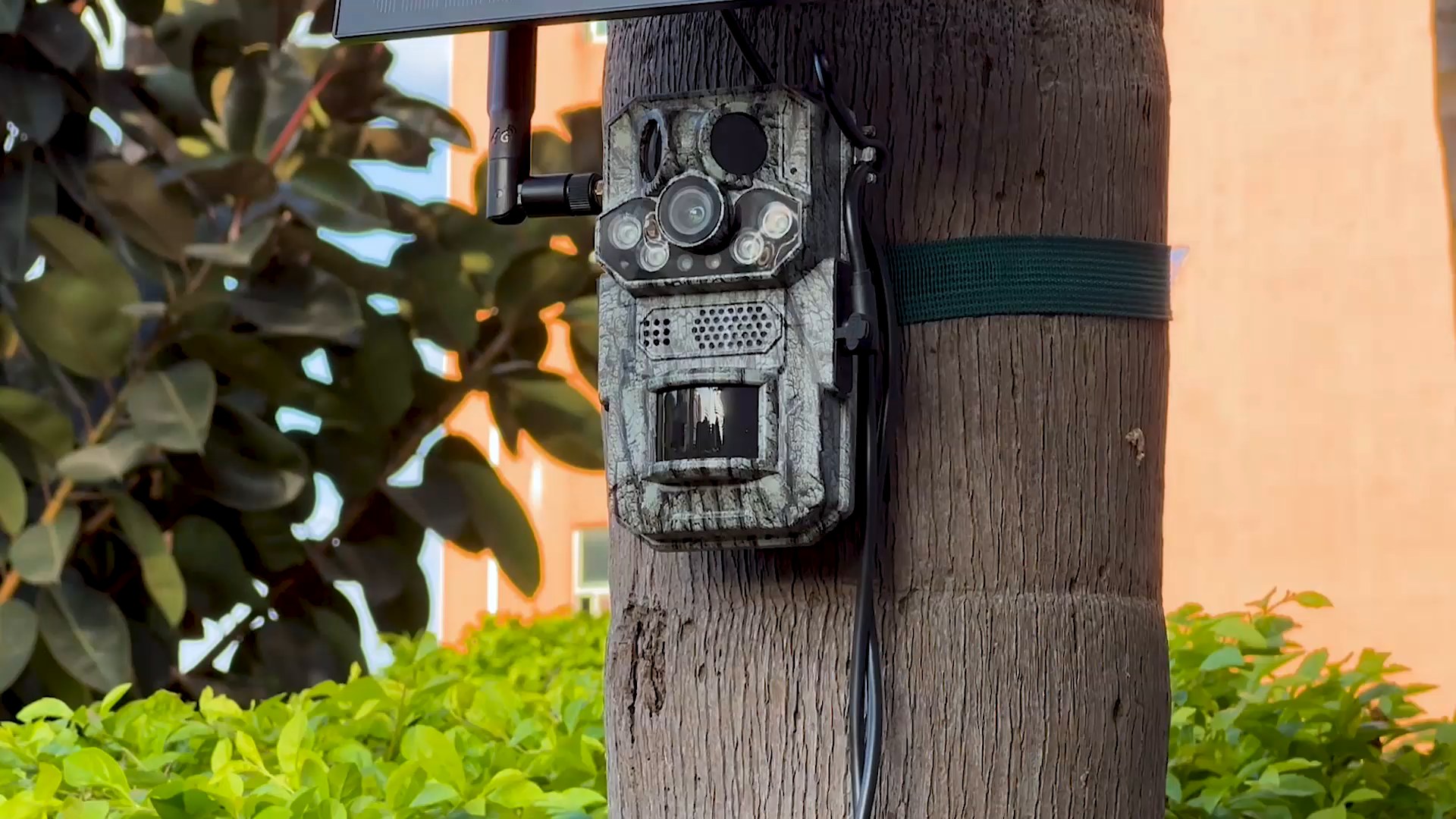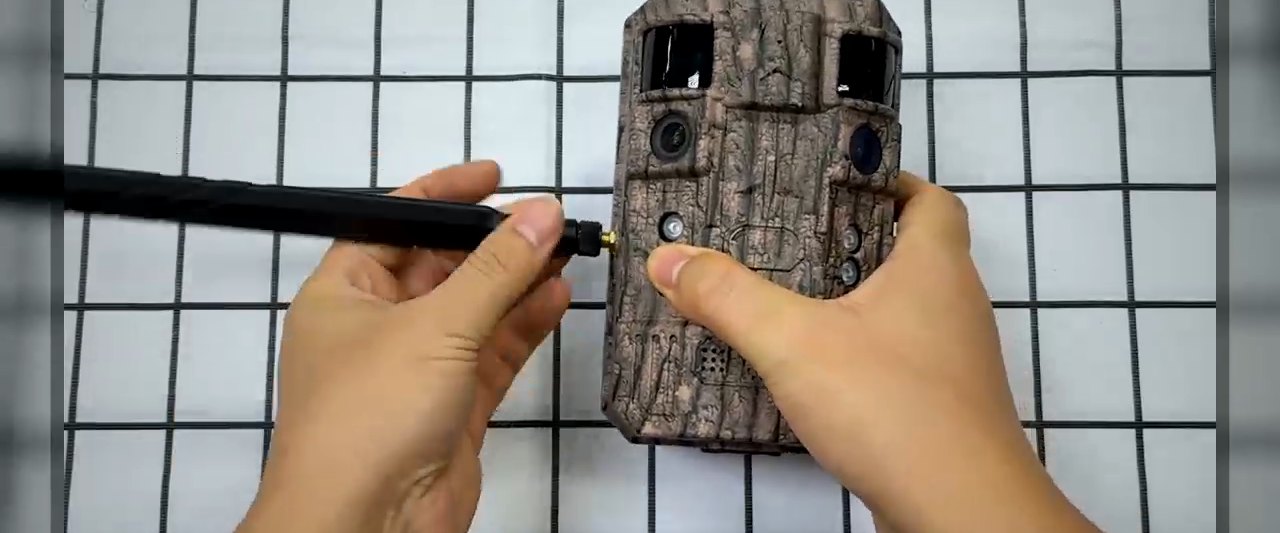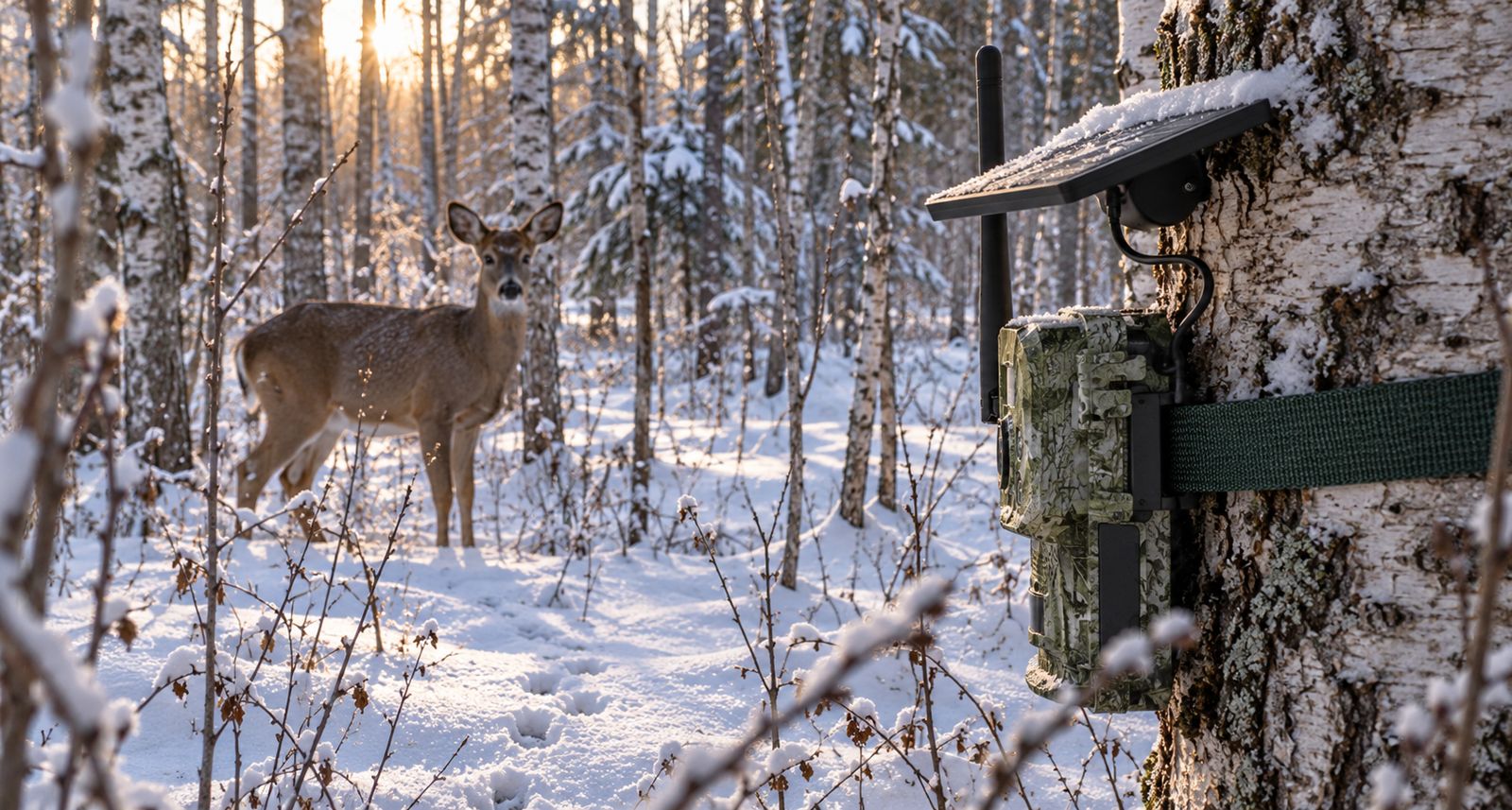
In short: A solar trail camera runs from a built-in lithium battery, and a small panel refills that battery in daylight. In a spot with direct sun, the panel keeps up with daily 4G uploads and night photos. In shade or a long gray spell it falls behind, and the size of the battery decides how long the camera keeps working until the sun comes back.
How a solar trail camera gets its power
The panel does not run the camera. The battery does. The panel’s only job is to put back what the camera used since the last sunny hours.
Every camera in our range pairs a 5 W solar panel with a built-in lithium pack. The HC809, HC810 and HC808 carry 7,800 mAh. The HC828, which runs two 12 MP sensors and two PIR sensors, carries 15,600 mAh.
This replaces the stack of AA batteries many cellular game cameras still use. The owner does not walk in to swap cells, and the camera does not go dark in the middle of the season because the last set ran flat.
What uses the most power
A trail camera spends most of its day asleep, waiting for the PIR sensor to see warm movement. Sleeping costs very little. The power goes after a trigger, and two jobs take most of it:
- 4G uploads. Every photo sent over the cellular network costs power. Weak signal makes it worse, because the modem has to work harder and may have to try again.
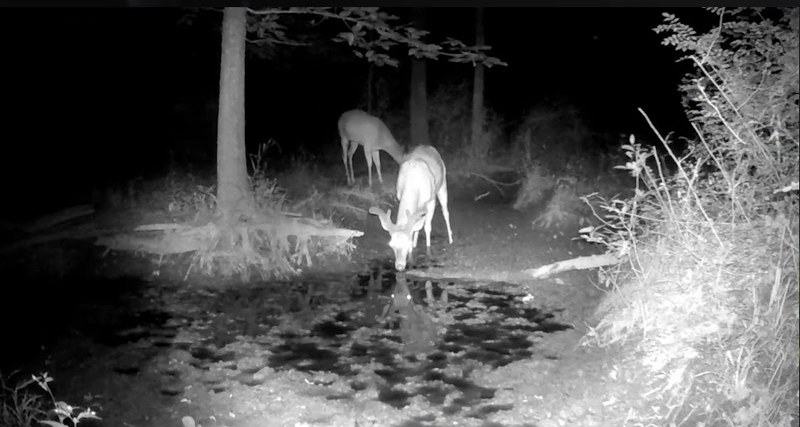
- Night infrared. After dark, the camera fires its infrared LEDs for every photo. A busy night at a feeder can mean dozens of infrared shots.
Saving a photo to the microSD card is cheap by comparison.
So a camera on a quiet ridge with good signal asks little of its battery. A camera on a busy food plot with one bar of signal asks a lot. Same camera, very different power budget.
Battery size and a cloudy week
On a sunny day the panel refills the battery. On a gray day it puts back only a fraction. Over several cloudy days in a row, the camera keeps taking and sending photos while the battery slowly drops.
This is where pack size matters. A larger battery is a longer buffer. It carries the camera through a wet week in October or the short, low-sun days of December, and gives the panel time to catch up when the weather clears.
| Model | Battery | Solar panel | Night infrared | Where it fits |
|---|---|---|---|---|
| HC828 | 15,600 mAh lithium | 5 W | 950 nm no-glow | Wide fields, food plots, long gray spells |
| HC809 | 7,800 mAh (3 x 18650 cells) | 5 W | Four 940 nm no-glow LEDs | Trails and long shots, fast trigger |
| HC810 | 7,800 mAh lithium | 5 W | 940 nm no-glow | Dusk movement, color in low light |
| HC808 | 7,800 mAh lithium | 5 W | 940 nm no-glow | Broad detection with three PIR zones |
There is no honest single number for days on battery alone. It depends on how many triggers the camera sees, how strong the signal is, how cold it gets and how much sun the panel had before the weather turned. The cameras are rated from -22 to 140 F (-30 to 60 C), but cold still takes something out of any lithium pack. If a buyer’s land sees long cloudy spells or heavy traffic, the larger pack is the safer choice.
Where to put the panel
A panel keeps up only in direct sun. Bright shade and dappled light through leaves give far less charge than open sky. In the northern hemisphere:
- Face it south. That is where the sun spends the day. A panel facing north gets little direct light for most of the year.
- Tilt it toward the sun. Angle it up toward the sun’s path across the southern sky. The winter sun sits lower, so a steeper tilt helps from November to February.
- Clear the leaves. Look up before you strap it on. A spot in open sun in March can be in full shade once the trees leaf out. Check the spot for the season the camera will run, or trim what will grow into the way.
The camera and the panel have different jobs. The camera faces the trail. The panel faces the sun. Choose a tree where both can do their job. On the edge of a field or clearing that is usually easy. Deep in thick timber, it may not be.
Wipe the panel when you check the camera. Dust, pollen and snow all cut the charge.
What a store or seller should stock
Buyers who pick a cellular camera usually want to hang it and leave it. Solar with a built-in battery is what lets them do that, so it is worth explaining at the counter and in every listing.
- Hunting stores: carry the HC809 as the everyday camera, and the HC828 for customers watching fields and food plots, where the 180 degree frame and the larger pack both matter.
- Amazon sellers: put the solar panel and the included SIM near the top of the listing. Shoppers compare running cost, and a camera with no batteries to buy and no brand data plan is easy to explain. Our cellular vs Wi-Fi guide covers the questions they ask next.
- Farm and ranch buyers: for gates, barns and yards, look at our camo solar cameras as well.
See the full range of trail cameras. Orders start at 50 units. To sell under your own brand, see OEM and private label. For placement and setup questions, visit support, and for prices and lead times, contact our sales team.