In short: The US version of our cameras supports the main LTE bands of AT&T, T-Mobile and Verizon, and takes a nano SIM from any of them. It does not support B71, T-Mobile’s 600 MHz band, or B14, AT&T’s FirstNet band. On rural land where T-Mobile only reaches on 600 MHz, use an AT&T or Verizon SIM. Before a volume order, test a sample on the carrier your customers use.
Why the band matters more than the carrier name
A carrier is not one radio signal. Each network broadcasts on several LTE bands, and each band is a numbered slice of radio spectrum. A camera connects only if it supports at least one band the nearest tower is using.
Low bands, under 1 GHz, travel far and pass through trees. They carry most of the signal in the countryside. High bands carry more data over shorter distances and are used more in towns.
For a trail camera on a ridge or in a creek bottom, the low bands are the ones that count. In the US those are B5 (850 MHz), B12, B13 and B14 (all 700 MHz) and B71 (600 MHz).
Band overlap on the three US networks
The US LTE version supports 16 bands: B1, B2, B3, B4, B5, B7, B8, B12, B13, B18, B19, B20, B25, B26, B28 and B66. Here is how that lines up with the bands each carrier relies on.
| Carrier | Main LTE bands | Supported by our US version | Not supported |
|---|---|---|---|
| AT&T | B2, B4, B5, B12, B14, B17, B30, B66 | B2, B4, B5, B12, B66 | B14 (FirstNet), B30; B17 see note below |
| T-Mobile | B2, B4, B5, B12, B66, B71 | B2, B4, B5, B12, B66 | B71 (600 MHz) |
| Verizon | B2, B4, B5, B13, B66 | B2, B4, B5, B13, B66 | None |
So the camera overlaps with all three networks on both low and mid bands. The gaps are worth knowing:
- T-Mobile B71. T-Mobile leans on 600 MHz for coverage in rural areas. Where that is the only T-Mobile signal, the camera cannot connect on T-Mobile.
- AT&T B14 and B30. B14 is the FirstNet band, built for public-safety users. B30 is a mid band used mostly for capacity in towns. AT&T’s other low bands, B5 and B12, are both on the camera’s list.
- AT&T B17. It is not on the list either, but B17 sits inside the B12 range, and B12 devices generally work on it.
- Verizon. Every band in Verizon’s core list is supported, including B13, its main 700 MHz band.
Prepaid and discount carriers run on one of these three networks, so the same rules apply. A SIM from a brand that uses T-Mobile’s network has the same 600 MHz gap.
Why a phone test can mislead
The easy check is to stand at the tree and look at the bars on your phone. It helps, but it is not proof. A T-Mobile phone showing two bars may be on B71, which the camera cannot use, and most phones show bars without saying which band they are on.
Better checks:
- Look at the carrier’s coverage map for the property.
- If the land looks like T-Mobile country only, try an AT&T or Verizon SIM before blaming the camera.
- Hang the camera, insert the SIM and wait for a test photo in the Ucon app before you walk out. That is the test that counts.
SIM in the box, or any local SIM
Many US trail camera brands tie each camera to their own monthly data plan, roughly $5 to $23 per camera per month.
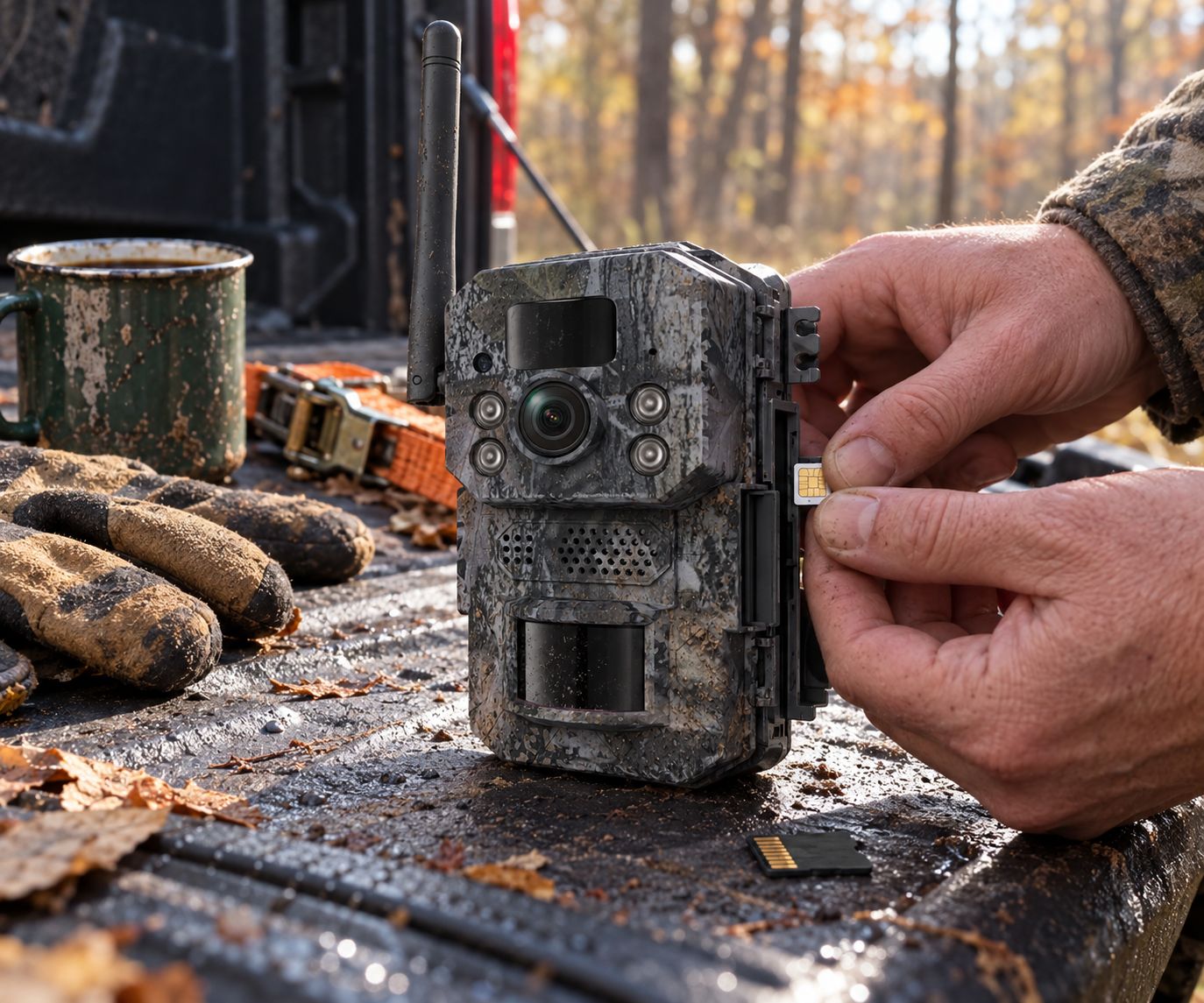
Ours work differently. Each camera ships with a SIM card we have tested on it, ready to activate. Owners can also use a nano SIM from any local carrier, and there is no GoTrailCam data plan. We recommend the included SIM: it has been tested with the camera and gives the most stable connection. Cloud storage is optional in the Ucon app, and AI animal recognition is free for the first year on the HC808, HC809 and HC828.
For a store, that means a customer can start with the SIM in the box or use the carrier they already trust. The band table above shows which carriers can serve the camera where they hunt.
The module, and volume orders
The cameras use an LTE module from SIMCom, a large module maker. SIMCom holds regulatory and network approvals for its modules in the major markets and publishes them on its certification page.
If you plan to sell in volume on one carrier, do two things first:
- Ask sales which module and band set your version uses.
- Test a sample on that carrier, in the kind of country your customers hunt, before the full order.
Order the US version for US customers. EU and Global LTE versions are built for other markets; ask sales for their band lists.
What a store or seller should stock
- The US LTE version for US shelves and US listings. Say “US version” in the listing title or bullets so buyers do not order the wrong one.
- The HC809 as the everyday model. Its 5 dB external antenna is useful on land at the edge of coverage.
- One question at the counter: which carrier works at your hunting spot? If the answer is T-Mobile only, suggest the customer check AT&T or Verizon coverage there too.
Browse the trail cameras and, for farms and yards, the camo solar cameras, or compare connection types in our cellular vs Wi-Fi guide. Setup help, including SIM questions, is on the support page. For module details, samples or a quote from 50 units, contact us. To sell under your own brand, see OEM and private label.