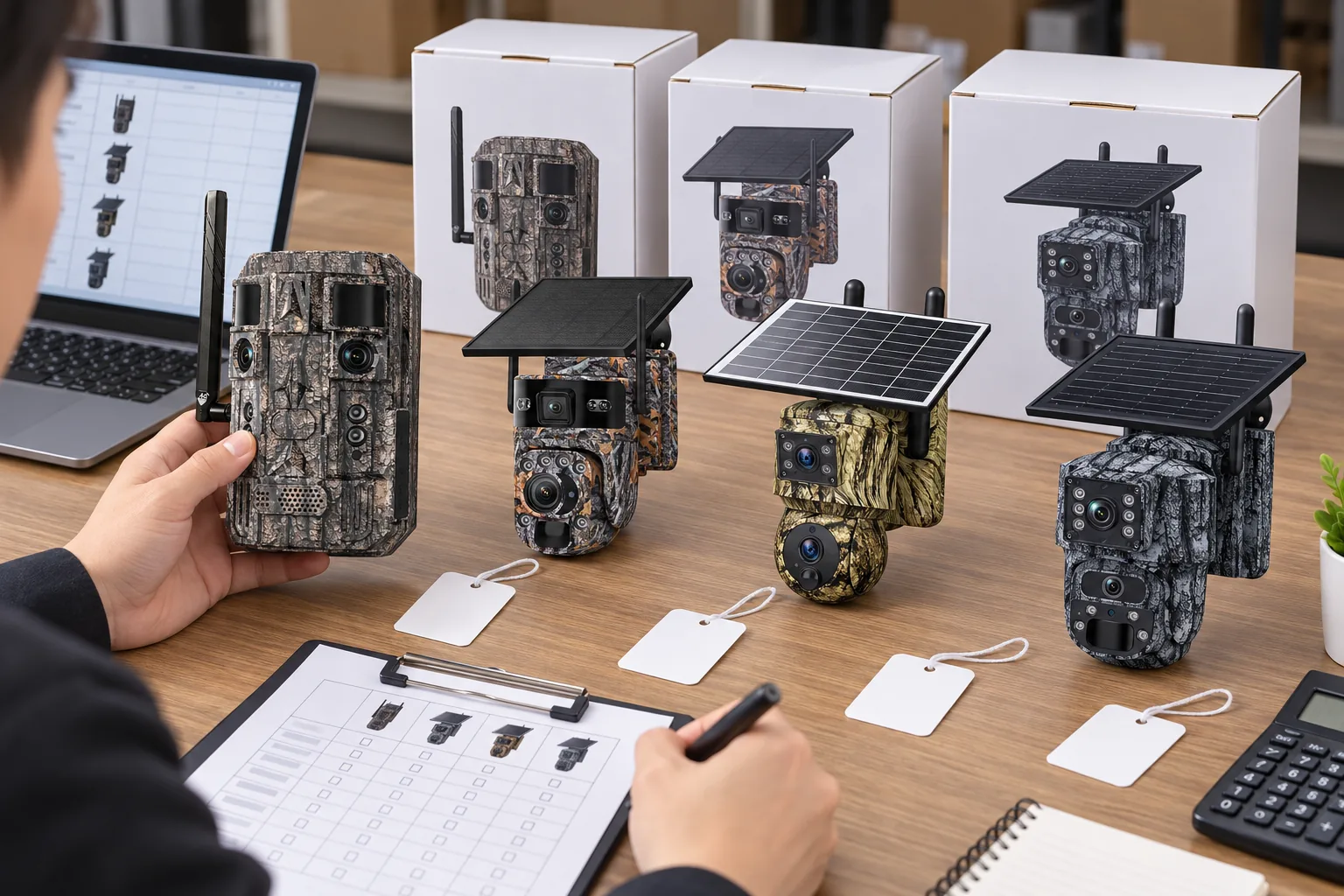
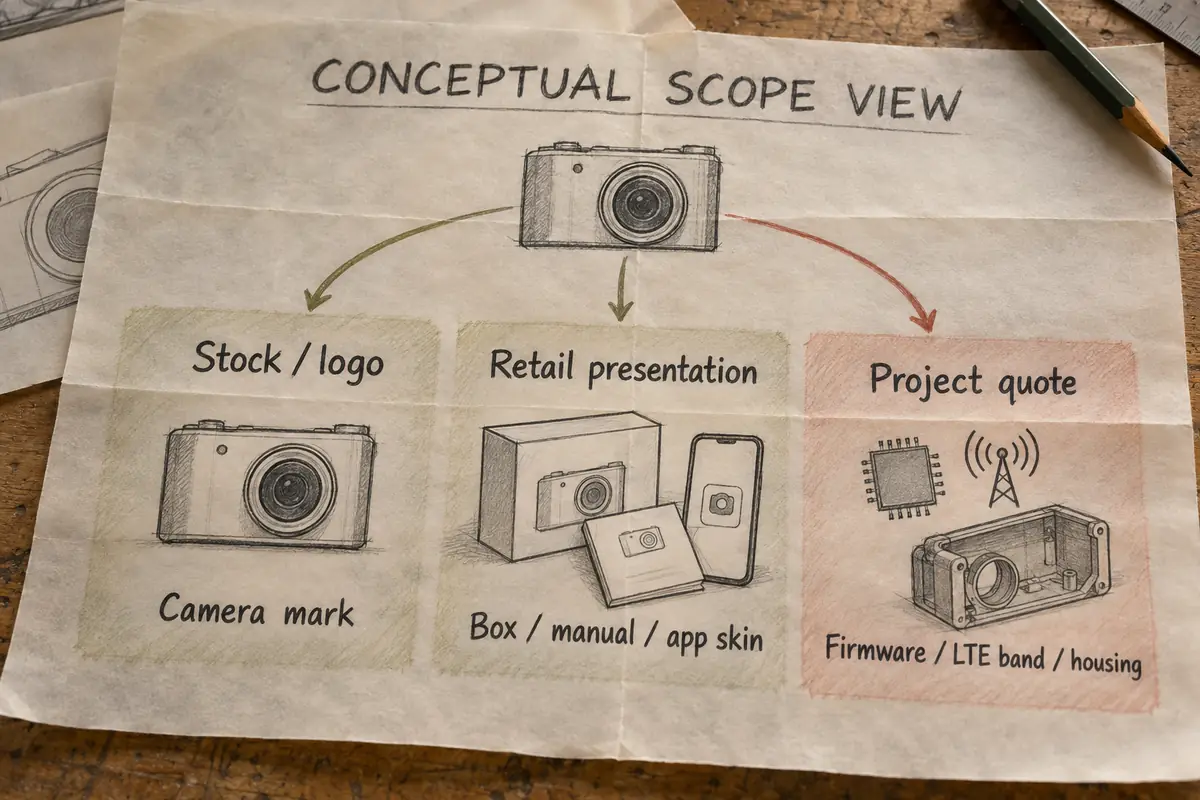
For a private label trail camera launch, some sellers carry more camera variations than they can stock comfortably while working against a date that leaves little room for relabeling or packaging changes. A private-label trail camera is sold under the buyer's brand. In GoTrailCam's listed offer, customization ranges from a logo on a stock model to project-quoted changes to the housing, firmware, or radio bands. The buyer's first choice is which product features and customer-facing materials need branding, followed by a quantity and schedule the business can accept.
Short answer
Our minimum order is 50 units for stock cameras or a buyer logo on the housing and label. Stock orders ship in 3–7 days; logo orders take about two weeks. See Tier 2 for the retail-presentation quantity, scope, and timing. Custom firmware, LTE bands, or housing are quoted per project.
These are different scopes, not interchangeable ways to describe one MOQ. Before requesting a quote, decide whether the product itself can remain a selected stock model, whether customer-facing materials need your identity, or whether a technical change is central to the product plan. Keep “ships” separate from arrival at your warehouse: the stated timings do not give a freight or customs estimate.
At a glance
- Stock or logo: 50 units; stock ships in 3–7 days, while adding a logo takes about two weeks.
- Retail presentation: see Tier 2 for the listed quantity, scope, and timing.
- Technical changes: custom firmware, LTE bands, and housing are quoted per project, with engineering and certification included in the project scope.
- Samples and production: samples are 1–3 units, ready in 3–7 days; production is about four weeks and each batch comes with a QC report.
- Price: request a quote with the model, quantity, destination market, and branding scope.
Choose the customization tier before you calculate the order
The most useful first question is not “What is the lowest MOQ?” It is “Which components must carry my brand at launch?” A logo-only order, a complete retail presentation, and a technical development project put different work into the order. Selecting the wrong tier can leave a seller with a minimum quantity that fits the budget but not the product presentation, or a customization request that needs a separate engineering discussion.
Tier 1: stock camera or logo, 50 units
The stated minimum order is 50 units. The offer associates that level with stock cameras or adding the buyer's logo to the housing and label. Stock units have a stated shipping time of 3–7 days, while an order with logo printing takes about two weeks. Those are the stated preparation or shipping intervals; they are not promised arrival dates.
This tier fits a buyer who wants to test a private label trail camera without first committing to custom customer-facing materials or technical design. A camera logo does not cover every part of the unboxing experience. If your marketplace listing promises branded packaging or an app interface, list those requirements separately in the quote request.
Buyers comparing a custom trail camera with logo should ask which surfaces or labels will carry it, which artwork version is approved, and what packaging the selected model uses. A written approval record can reduce ambiguity about whether a printed mark, carton, label, or listing image is part of the order.
Tier 2: your box, manual, and app skin, from 500 units
From 500 units, the offer lists a buyer's retail box, manual, and app skin, with a lead time of about four weeks. The listing does not say that this tier automatically includes a redesigned camera housing, custom firmware, or a different LTE band. Treat those as separate technical questions and request written confirmation if they are required.
This tier is relevant when the brand promise depends on more than a camera logo. Decide which customer-facing elements are needed for the first release; if only some are required, request that exact combination in the quote.
The company identifies a logo placement guide, retail-box dieline, and app-skin specification as available files for the buyer's designer. Request the current files from the OEM page and have the designer work from those versions rather than building artwork around guessed dimensions.
Tier 3: firmware, LTE bands, or housing by project quote
Custom firmware, LTE bands, and housing are quoted per project, with engineering and certification included in the project scope. No fixed MOQ or price is listed for this tier.
Bring a short requirements brief to this discussion. State the target sales markets, intended model or reference product, requested change, and why it matters to the buyer. For radio configuration, list the destination market and carrier requirements you want evaluated. For a housing change, explain what must differ and what can remain as-is. For firmware or app work, describe the required behavior in observable terms.
GoTrailCam says it signs an NDA before work involving the buyer's housing, firmware, or app. It also says the buyer owns artwork and app-skin files, which the company retains to reproduce a later order. Do not expand that statement into ownership of firmware, tooling, source code, or every design element; confirm those rights in writing if a project involves them.
Trail camera MOQ, lead time, and price are separate questions
MOQ describes the stated order threshold; lead time describes a stage in preparing or shipping an order; price is the amount quoted for a defined scope. Mixing these questions creates avoidable assumptions. A 50-unit minimum does not tell the buyer the price of every camera model, and a stated shipping interval does not tell the buyer when cartons will clear customs or reach a fulfillment center. The available product offer publishes no comparable price schedule or amount, so this guide does not estimate a dollar figure.
Use the published figures as a scope map for a private label trail camera, not as a complete landed-cost model:
| Buyer requirement | Stated scope | Stated timing | What remains to confirm |
|---|---|---|---|
| Stock model | 50-unit minimum | Ships in 3–7 days | Model, configuration, freight, and arrival estimate |
| Logo on housing and label | 50-unit offer | About two weeks | Artwork approval, exact logo placement, packaging scope |
| Own box, manual, and app skin | From 500 units | About four weeks | Final files, version approval, shipment and freight details |
The quantities and timings in this table describe GoTrailCam's offer, not an industry benchmark. Use the “what remains” column as an RFQ checklist for terms to confirm.
For a quote that can be compared with another supplier's proposal, define the same basket of requirements in each request. Include the model, quantity, logo treatment, packaging and manual scope, app-skin scope, any technical change, destination market, and whether the requested amount should show freight separately. Ask how samples are priced and whether freight, taxes, or import charges are included. A quote without a shared scope is not a like-for-like comparison.
Avoid treating “cost” as factory unit price alone. As a buyer-side planning exercise, separate product and branding scope from artwork preparation, freight and import costs, marketplace preparation, and any compliance work that applies to the destination. This is a way to organize your own budget, not a statement of GoTrailCam's charges. No price, discount, sample fee, payment term, or freight rate is specified here; get those in the written quotation before committing.
From sample to production: create approval gates
The published order sequence is inquiry, sample, configuration, pilot run, certification, and production. Configuration may cover bands, GPS, logo, box, and app skin; the pilot run is described as a first carton for the buyer's own test. Production is stated at about four weeks, with a QC report for each batch.
1. Send an inquiry that defines the product
Identify the model you want to evaluate, the intended quantity, destination market, and branding level. If you are not sure which camera is the best fit, shortlist based on the use case and ask the supplier to confirm the configuration. This is a practical recommendation: the OEM page itself asks buyers for model, quantity, market, and branding scope when requesting a quote.
2. Evaluate a sample before approving artwork at scale
Samples are listed as 1–3 units, ready in 3–7 days. The sample price is not stated. Use a sample to examine the specific model and build your internal checklist: test the setup steps you expect customers to follow, inspect the screen and controls, and check whether the selected model matches your listing plan. These are buyer evaluation suggestions, not claims about undocumented test results or product performance.
Write down what the sample does and does not represent. If the final order will use different packaging, a logo, an app skin, or a technical change, ask which elements are represented in the sample and which require a later approval.
3. Freeze configuration and artwork versions
Configuration is a named step in the published process. The listed topics include bands, GPS, logo, box, and app skin. Before signing off, keep a single record of the selected model, requested options, approved logo artwork, box files, manual, and app-skin version. This version-control step is a buyer recommendation; it helps both sides identify what the approval covers without implying that a particular file format or approval system is mandatory.
4. Review the pilot carton
The OEM process describes a pilot run as a first carton for the buyer's own test. Agree in writing on what you will inspect and how you will report discrepancies. For example, compare the received sample against the approved model and packaging files, then check that the labels and manual match the final proof.
5. Confirm compliance scope before production release
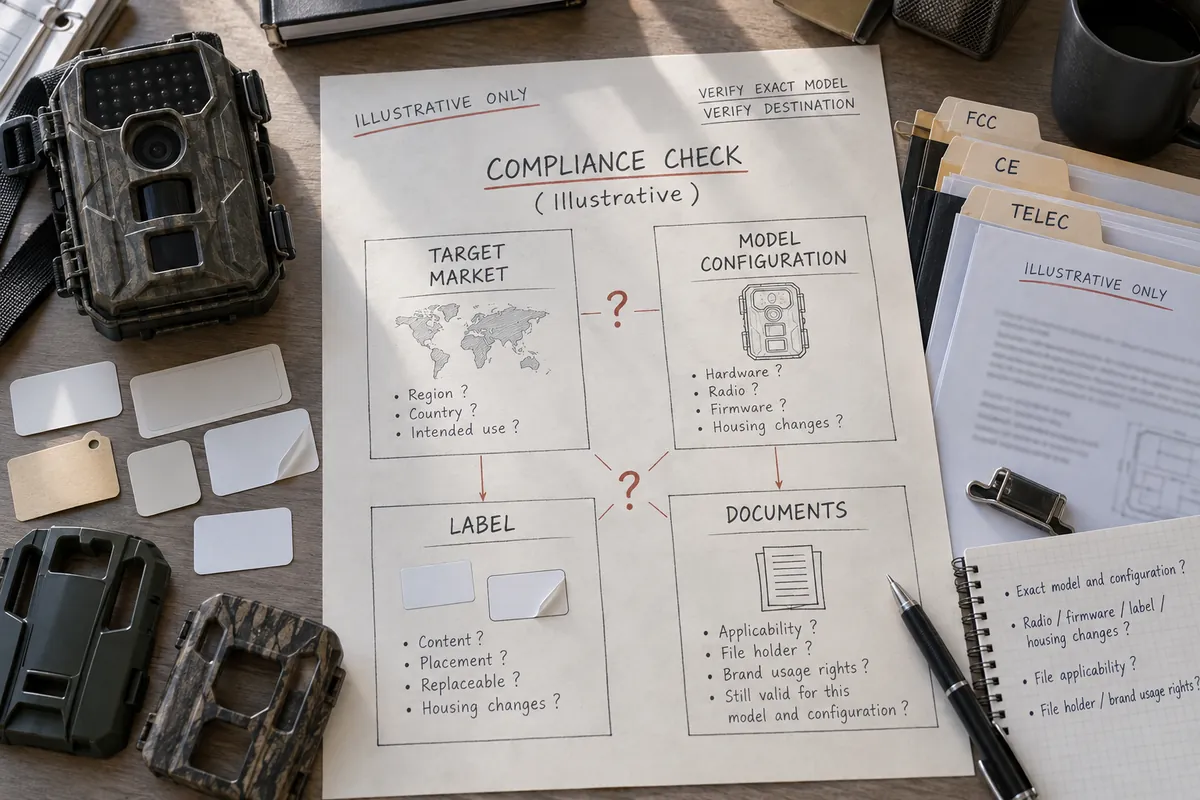
The order sequence includes a certification stage, and the site lists FCC, CE, and TELEC as examples associated with certification according to the buyer's market needs. That does not establish that each custom configuration has a transferable approval. Request the exact documents and identifiers applicable to the selected camera, radio module, configuration, and sales market. Have the responsible importer or compliance adviser confirm that the evidence matches the product being placed on the market.
6. Confirm production records and warranty terms
Production is listed at about four weeks, and each batch is accompanied by a QC report. Every camera carries a two-year warranty. The available information does not describe warranty exclusions, return freight, remedy timing, or claim procedures. Ask for those operating details in the order terms rather than assuming the duration answers every service question.
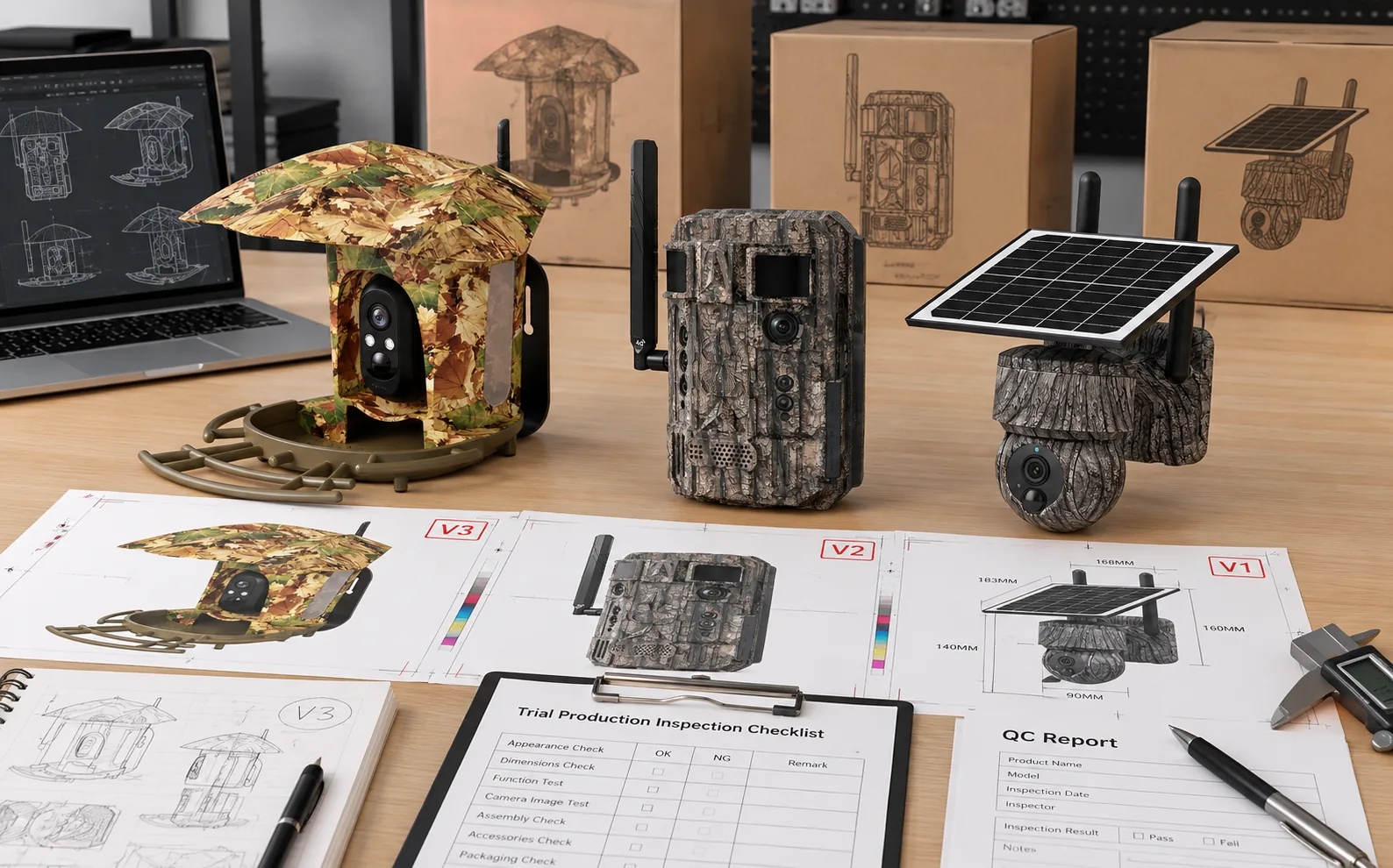
Prepare the RFQ files and market details
A buyer can speed up a trail camera OEM conversation by separating creative files from technical and commercial requirements. Do not send a logo and assume that it defines the whole private-label request. The available OEM materials include a logo placement guide, retail-box dieline, and app-skin specification; the order configuration topics include bands and GPS as well as brand elements.
Brand and packaging files
Prepare editable logo artwork and request the current logo placement guide before finalizing the design. Ask for the current retail-box dieline before laying out a carton, rather than guessing its dimensions, bleed, panel order, or print specifications. A designer may also need the app-skin specification before preparing interface artwork.
Keep the proof approval clear: identify the file name or revision you approved, the surfaces it covers, and whether the same artwork should appear on the camera, label, box, or manual. That recommendation is about avoiding ambiguity. It does not broaden the documented ownership statement beyond artwork and app-skin files. GoTrailCam says those files belong to the buyer and are retained to support repeat orders.
Product and channel requirements
Tell the supplier where the cameras will be sold and whether the first release is for an online marketplace, your own site, or a distributor channel. Add the quantity you are considering, preferred model, required branding tier, and any market-specific labeling or documentation request. These inputs make the quote request more concrete; they do not guarantee approval or define an exhaustive intake form.
For cellular models, state the destination country or region and the radio bands or carrier requirements you need checked. The configuration step lists bands as a topic, and custom LTE bands are handled as a project quote. Do not infer carrier compatibility from a product category or from another model's paperwork. Ask for written confirmation for the exact model and configuration.
The operating company is identified as Wuhan Morntrip Supply Chain, a Wuhan trading company, while manufacturing is in Shenzhen. Buyers who need to name a contractual seller, exporter, manufacturer, or importer of record should confirm the relevant legal entities and roles in the transaction documents rather than treating those roles as interchangeable.
Certification and market compliance: ask, do not assume
A private label is a brand arrangement, not proof that a radio product meets every rule in every destination. The exact obligations can depend on the product, radio configuration, market, labeling, documentation, and parties placing it on sale. For a US launch, buyers should check the applicable requirements for the exact device and market; the FCC advisory concerns businesses marketing RF devices and SDoC procedures, not a single authorization path for every trail camera or private-label configuration.
For an EU launch, the European Commission describes the Radio Equipment Directive as the framework for placing radio equipment on the EU market, including essential requirements covering health and safety, electromagnetic compatibility, and efficient use of radio spectrum. This overview helps identify a compliance question; it does not determine whether a particular private-label configuration complies.
The OEM offer includes a certification stage and names FCC, CE, and TELEC as examples depending on the buyer's market needs. The referenced FCC Supplier's Declaration of Conformity covers named ST-series models; it is not an FCC ID grant and cannot be presented as reusable under a buyer's brand. Ask which documents apply to the exact model and configuration, who holds them, and whether a radio, firmware, label, or housing change affects the evidence. Confirm requirements for the product and destination market with a qualified local compliance adviser.
Use the official sources as starting points, not as a substitute for product-specific review: FCC equipment authorization advisory and the European Commission overview of the Radio Equipment Directive. If the destination market is outside these examples, ask a qualified local compliance adviser which authority and requirements apply.
Common mistakes that delay a private-label launch
Treating 50 units as the threshold for every form of customization. The 50-unit offer covers stock or logo scope; consult the listed tiers before adding retail presentation or technical changes to an RFQ.
Turning a ship date into a delivery promise. Stock is stated to ship in 3–7 days and logo orders take about two weeks, but the offer does not provide a destination arrival estimate. Ask for the freight basis and transit estimate separately.
Assuming a logo order includes custom retail packaging. The listed own-box, manual, and app-skin scope starts from 500 units. If the unboxing experience matters, say so explicitly and get the scope and quantity confirmed.
Using a certification reference without matching the exact configuration. The cited FCC SDoC is tied to named ST-series models and is not an FCC ID grant; the available information does not establish that a buyer can simply reuse it under a different brand. Confirm the applicable authorization and documentation for the product you will sell.
Leaving project rights and acceptance criteria vague. Artwork and app-skin file ownership are stated; broader firmware, tooling, and source-code ownership are not. If a project touches those areas, record the deliverables, acceptance checks, confidentiality terms, and rights in the project agreement. An NDA is stated for projects involving housing, firmware, or app work.
FAQ
What is the MOQ for a private label trail camera?
GoTrailCam lists stock cameras or a logo on the housing and label from 50 units. See Tier 2 for retail presentation; custom firmware, LTE bands, and housing are quoted by project.
How long does a private-label order take?
Stock cameras are stated to ship in 3–7 days; logo orders take about two weeks; and the listed box, manual, and app-skin tier takes about four weeks. Treat these as preparation or production timings, not an arrival guarantee.
How much does trail camera OEM cost?
Request a written quote tied to model, quantity, logo and packaging scope, app work, technical requirements, destination market, and freight basis. Do not compare unit prices until the scope and included costs match.
Can I start with a small sample order?
The stated sample quantity is 1–3 units, ready in 3–7 days. Sample pricing is not specified, so request it with the quote. Confirm whether the sample represents the final model and which branding or packaging elements, if any, are included.
Can the buyer use the existing FCC or CE documents under a new brand?
Do not assume a document transfers with the label. The referenced FCC SDoC applies to named ST-series models, is not an FCC ID grant, and cannot be reused under the buyer's brand. Ask which documents apply to the exact configuration and consult a compliance professional for the destination market.
Who owns the custom artwork and app skin?
GoTrailCam states that the buyer owns artwork and app-skin files, which are retained for repeat-order reproduction. This statement does not establish ownership of firmware, tooling, source code, or all project designs; document those separately if they matter to your order.
Request a quote with a defined scope
Choose the camera and branding tier first, then send the quantity, target market, requested custom elements, and files or questions that affect the quote. For a stock or logo order, say whether the camera itself or its packaging needs branding. For a 500-unit presentation package, identify box, manual, and app-skin requirements. For a private label trail camera RFQ, name the model and the elements that need the buyer's brand, then request a project quote for technical changes. Buyers searching for a white label game camera can use the same scope-first approach. The OEM page is the relevant route for the listed offer and inquiry form.
Browse the trail camera catalog and full product catalog to identify models for an RFQ; compare candidates such as the HC808 triple-PIR 4G camera and HC809 solar 4G trail camera against the required configuration. The camera comparison page offers another route for evaluating models, while the OEM program overview describes the listed private-label scope. Send confirmed requirements through the contact page.
Before placing an order, make sure the quote states what is included, what remains unpriced, which files and configurations are approved, how the sample and pilot carton will be evaluated, which compliance documents apply, and how delivery timing is calculated. Ask for the answer in writing so the purchase decision is based on the same scope that production will follow.